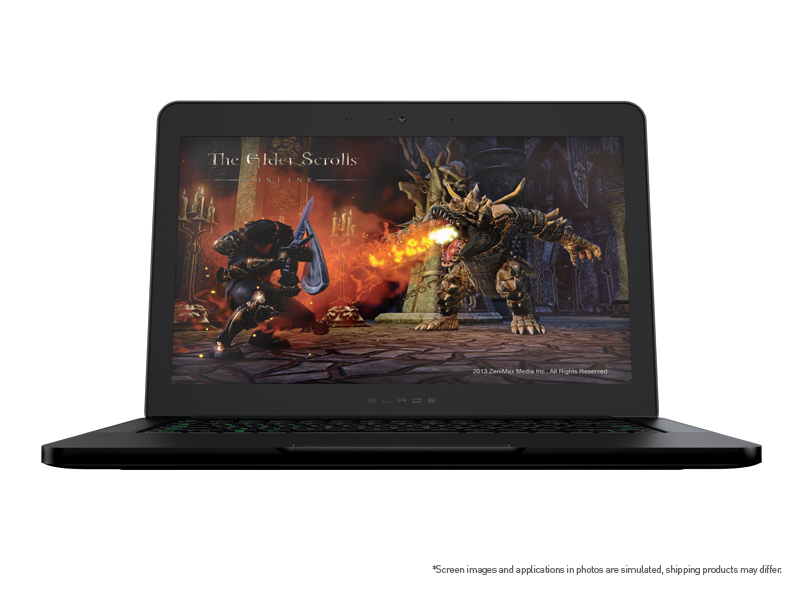
The well known gaming peripherals manufacturers has been putting quite some work in new waters, with first unveiling the Edge gaming tablet, and now what they claim to be the 'thinnest gaming laptop' - the Razr Blade , at a thickness of 0.66" (16.8mm). Thickness is one thing, but what matters more is the performance , for a device dedicated for hardcore gaming, and believe me, the laptop is gonna seriously slice the competition.
The 14 inch HD+ LED screen has a resolution of 1600 X 900. Powered by the to-be-launched Intel 4th Generation Processors, named as Haswell, it surely has beaten Apple, which was looking to try to be the first to unveil a 4th Gen processor powered laptop , in the next of the Macbook series. Leaving that aside, the Blade has the muscle power of the latest NVidia GeForce GTX 765M GPU 2GB GDDR5 VRAM , which is more than enough to take on anything you throw at it, and that means something really.
Razer Blade has 8GB DDR3 RAM, and storage in form of SATA III SSD only, with 128, 256 and 512GB variants. It has USB 3.0 ports, and supports Bluetooth 4.0 . You can preorder the laptop from tomorrow, that is June 3 , at a pretty decent starting price of $1800, with higher price for higher SSD storage.
You can check out the official video below. Do comment and rate it, and stay tuned for the latest updates in the world of technolgy
This is what Intel itself claims, according to whom, the 4th generation Haswell processors are going to be a great upgrade over the Ivy Bridge microarchitecture in terms of being as much as 20 times more energy efficient, without compromising on the performance side. That would be a much sought relief to consumers as well as laptop and macbook manufacturers, who have been facing the battery life issue for quite some time, temporarily though.
The Haswell processors , with the nanoseconds ticking, are going to be launched next month at the Computex show in Taipei.
With this launch will start a race among the laptop manufacturers to offer the latest of intel 'inside' , and from current speculations, Apple could be winning this race this time, with its Macbook range looking towards being among the first to get the 4th gen Haswell upgrade. according to reports, which are going to see the light of the day at WWDC (Apple Worldwide Developers Conference) on June 10
Well Intel has announced the time left for the launch of the 4th generation member of the uber successful Core series of processors, named Haswell , and as you can see in the pic, that is the value in terms of nanoseconds. For your convenience, I calculated it down, and it ends up being 38 days from now. Frankly, its really hard to keep excitement down for me, because you can safely expect your personal computer and lappy to break some power limiters with the 4th gen monster inside.
If you remember from earlier, Intel 4th gen processors are to get a voice and gesture control option in them . The Haswell has the same 22 nm microarchitecture as the 3rd gen Ivy Bridge, but it has better energy efficiency, more power (double the CPU and GPU as Ivy Bridge), and many expected security advancements. It will be upto a quad core version only, inspite of many wanting octa core PC’s after Exynos 5 Octa core in Samsung Galaxy S4, but that will be the case for the Intel 5th generation Broadwell , which will be made in 14nm microarchitecture. Though I am wishing for things to reach to 16 cores by then. Intel 4th gen Haswell has , by the way, new cache design, and more excitingly, possible support for the 20GB/s Thunderbolt !!!
Overall, the reason I postponed buying a laptop has at last arrived, and maybe we will see some great devices with ‘Intel inside’. Stay tuned for the latest updates on this new family of processors, as well as devices powered by them.
A super premium 2560 X 1440 resolution 13 inch touch screen display is what the Toshiba KIRAbook sports, clearly ready for a head on collision with the Apple Macbook Pro with retina display. And that's quite a change of temperament for the brand, which is known better for its low to mid range devices, and they surely intend to give quite a tough fight in the high end market with the KIRAbook now.
Windows 8 inside, powered by 3rd gen Intel core i5 or i7 processors, with a 256 GB of SSD storage , along with 8 GB of DDR3 1600 MHz RAM is what this high end laptop shows off. With a 52 Wh Li polymer non replaceable battery , claimed to last 6 hours surely looks impressive, especially when we take into consideration the energy hungry screen, which incidentally is made of Corning Gorilla Glass.Though 221 ppi as compared to 227 of Macbook Pro, and 239 or Cromebook Pixel is what KIRAbook has, it doesn't make much of a difference in viewing experience.
KIRAbook has an LED backlit keyboard, and supports Bluetooth 4.0 , has 3 USB 3.0 ports, wireless N Wifi connectivity, has Harman Kordon stereo speakers. The notebook is made up of AZ91 Mg Alloy body, which is jst 1.18 Kg in weight, and 0.7 inches thick, which is claimed to be 100% stronger than standard aluminium bodies.
On the software side, KIRAbook comes with factory installed Adobe Photoshop Elements 11 and Premiere Elements 11, along with Apple care comparable Toshiba Platinum service. Apart from this, they provide 25 gigs of cloud storage by Norton Online backup.
Pricing of the KIRAbook series is tad higher than Macbook, and that surely deflates a bit of the enthusiasm. Set to be up for pre order from 2nd May,and commercial launch by 13th May, the KIRAbook prices are
With the success of the iPad, it’s easy to forget that convertible units with a rotating hinge and physical keyboard were once the form factor of choice for tablet computers. While touchscreen-only devices now dominate the consumer space, convertible tablets continue to find a market, particularly amongst business and government users. It is these markets that HP is targeting with its latest touch-enabled convertible tablet, the EliteBook Revolve, which is due for a March, 2013 release.
Powered by third-generation Intel Core processors and with 4 Gb of RAM, the EliteBook Revolve features a touch-enabled, 11.6-inch, 1,366 x 768 pixel resolution display that pivots and twists to switch between traditional laptop and tablet form factors. The display is made from scratch-resistant Gorilla Glass 2, while the all-magnesium chassis helps keep the unit’s weight down around 3.04 lb (1.37 kg) – that figure is based on the preproduction model, as is the estimated 22.4 mm thickness of the device.
The full-sized physical QWERTY keyboard features a backlight and is spill-resistant, while the screen orientation and brightness will adjust according to the unit’s position. Connectivity features include optional WWAN (LTE in the U.S. and HSPA+ elsewhere), secure NFC, Bluetooth, Ethernet port, two USB 3.0 ports and a DisplayPort.
Onboard storage comes in the form of a 256 GB SSD, with a 720p HD4 camera positioned above the display, a dual-microphone array, DTS Studio Sound and CyberLink’s YouCam software also on board. An optional pen is also available for touchscreen input. The battery should be good for eight to ten hours of use, and 210 hours of standby.
Although it has been optimized for Windows 8, HP will offer the option of preloading the EliteBook Revolve with Windows 7 for those not yet prepared to jump on the Metro train.
The EliteBook Revolve is that latest bid by HP to grab a slice of the growing enterprise tablet market. In October it announced the business-orientedElitePad 900 boasting a rugged form factor and compatibility with Smart Jacket peripherals. The company has also announced a new Multi-Tablet Charging Module that can store and charge up to 10 tablet PCs with screen sizes under 10.1 inches from a single power outlet.
Like the ElitePad 900, the Multi-Tablet Charging Module will be available in the U.S. in January. It will be priced at US$499. Pricing of the EliteBook Revolve will be announced closer to its March, 2013 release date.
Gaming on a laptop has traditionally meant using massive desktop-replacement beasts tied to the power socket, with no hope of fun on the road.
On the flip side, trying to play modern titles on a machine with integrated graphics has generally meant staccato frame rates in the single digits.
But what if we told you that it needn't be that way? What if we told you that on an Ultrabook with only HD 4000 graphics we could have Crysis 2 running smoothly, and without too much sacrifice either?
Lucid Logix is a name that will be familiar to most readers as the company that allowed folk with Z68 or Z77 motherboards to use discrete graphics cards and still have access to the funky Quick Sync bits of the Ivy Bridgeand Sandy Bridge chips.
We went to see Lucid while we were over in San Francisco for IDF. Usually when we say that we mean we saw a representative, but not this time - we actually saw pretty much the entire company. A good chunk of its small team was in the room with us as Offir Remez, president and MD of Lucid, took us through the demos of the latest goodies.Functional, but not too sexy, right? Its new Dynamix software, though, can double gaming frame rates on integrated graphics, giving laptops without discrete GPUs serious gaming chops. Lucid Logix is a tiny company with big ambitions, and now it's got the software to match that ambition.
We saw its Virtu MVP Mobile software running on a laptop and a concept external GPU set up via a hot-swappable Thunderbolt connection - but it was the new software running on an Ivy Bridge Ultrabook that really impressed.
Crysis management
The little laptop, with its relatively feeble HD 4000 graphics, had Crysis 2sitting on it. While it's not quite the crazy-demanding game its predecessor was, it's still a graphics hog, so on the surface it might seem unfair to put the poor machine through the wringer with it.
And with the machine barely managing to hit 9fps it seemed like a pretty pointless exercise - nobody is going to play at those frame rates. That's where Lucid's Dynamix software comes into play, though.
A quick press of a pre-ordained key to enable it while still in the game, and suddenly the FRAPS frame rate counter jumped up to over 20. Suddenly it was playable and much, much smoother. A credible gaming experience on an Ultrabook - what voodoo is this?
It's a software-based solution, requiring no extra hardware and - in a first for Lucid - operating on a single graphics processor.
"We take everything we know how to do," says Offir. "We know every frame going into the pipeline. We capture it before, we analyse the tasks, we know what it's going to do. We sometimes distribute it between the CPU and GPU, and sometimes different GPUs.
"We said, 'Can we use that in a one GPU environment and walk the fine line between quality and performance?'" he continues. "Would you give up a small percentage of quality - we are playing with pixels here - to double performance? Let's say 2 per cent quality to double performance."
Dynamic Resolution Rendering
What Lucid is doing here is based on something Intel itself passed around at this year's Games Developer Conference (GDC) back in March - something called Dynamic Resolution Rendering. It was a concept which allowed better frame rates on lower powered hardware, while still retaining much of the visual clarity you want with high-resolution gaming.
But nobody wanted to know. The extra code needed to add this into the developers' game engines obviously wasn't seen as worth it for individual titles on a platform as seemingly niche as the PC.
Lucid though has taken this away from the games themselves, and is creating an ecosystem that it can add to a machine to enable the resolution switching in any game on the fly.
The essential idea is to dynamically adjust the resolution of the 3D scene so that it can run smoother and faster, while still keeping the GUI/HUD of the game rendered in the native resolution. That way the overlay doesn't expand and end up taking over the screen - as it would if you dropped resolution as a whole - and remains clear and crisp and out of the way of the 3D scene.
As Lucid's demonstration showed, dropping the resolution of the actual 3D scene itself this way doesn't harm the image quality too much, and adds a whole heap onto the performance side. You can also, as Lucid is doing with Dynamix, offset much of the image degradation of dropping resolution by using less GPU-intensive post-processing effects to help smooth things out.
The trade-off then is visual clarity. Because the new technology is enabled on the fly, you can immediately see the loss of fidelity - there's a faint smudging visible around the edges, like you'd see anyway running the game in a non-native resolution.
But when you're switching from unplayable-but-sharp to smooth and a little less clear, it's a pretty easy choice. And Lucid hasn't finished optimising yet and is confident it can sharpen things up more in future iterations.
If you want a completely high-end, high-resolution gaming experience then you're still going to need a discrete GPU. But if you just want to play a 3D title with smooth frame rates on your Ultrabook/integrated graphics processor, you're not going to be that bothered about a little loss of clarity.
At the moment Lucid is only looking at this in the mobile sphere, but we also spoke about whether the same could be applied to small form factor machines, the sort of little PCs you stick under your TV for media functionality
.Destop Dynamix
From the sofa the slight smudging is going to be barely visible, and with Valve and its big-screen gaming Steam initiative gaining traction, having a wee PC capable of gaming on your TV is actually quite desirable. This could really open up PC gaming to a whole new section of the PC world.
Now Intel is starting to take notice again and so are the laptop manufacturers. Lucid didn't fully realise just how well-received the software would be and is now being tasked with using it in the first round of Haswell laptops due for release in the middle of next year.
And if the 2x GPU performance of the 4th Generation Core Architecture holds true that could mean 40fps in Crysis 2 on an Ultrabook. Now that's tantalising.
Has 2012 been a vintage year for the PC? Things have certainly started to hot up with the release of Windows 8 and Microsoft Surface.
But epic in the sense of a computing platform going through a major transition. Exactly how successful that transition turns out to be we'll have to wait and see.
What is absolutely guaranteed, however, is that by the end of 2013 there will be PCs unlike anything seen before. New form factors. New capabilities. New value propositions.
What is a PC? It's changing...
So is an ARM-based PC really a PC? Similarly, is an ultra-mobile device powered by an Intel x86 chip but running Google's Android OS a PC? Or does a PC only mean the classic Wintel alliance of Microsoft Windows and Intel x86 processing?The answer to that question will become increasingly tricky during 2013. Microsoft has released a version of the Windows operating system that's compatible with ARM processors, for instance.
It's x86. But it runs Android. Is it a PC?
As the lines become increasingly blurred, perhaps it's device types that will matter, not the notion of a PC.
Tablet conversion
While that's playing out, devices that can definitely be called PCs in terms of ye olde Wintel thing will increasingly be available in tablet format.
The poster child for full-on PC tablets is obviously Microsoft's Surface Pro, due out early in 2013. On paper, it looks like one device to rule them all.
It's a proper x86 PC with an Intel Core i5 processor. It runs the full version of Windows 8 complete with the powerful desktop interface and compatibility with bazillions of legacy applications.
Is this the touch-feely future of the PC?
But it's also a tablet device with the Windows Modern touch interface. So, unlike Apple's iPad or any number of Android tablets, it's not an as-well-as device. It's instead-of. Instead of a laptop, that is.
So you'll have full touchscreen tablet functionality combined with traditional laptop content creation capability in a single, ultraportable device. Brilliant.
The only problem with Surface Pro is pricing. It'll probably cost £800 or more. Mercifully, the world and his dog will be producing tablet convertibles and touch-enabled laptops in 2013. So prices will tumble over the year.
Intel's Next Unit of Computing
It arrived at the end of 2012. But 2013 will be the first full year for Intel's Next Unit of Computing or NUC.
Superficially, NUC is just an ultra-compact PC little different from, say, a Mac Mini or any of a number of super slim boxes.
But NUC is important in terms of the predictions it makes about the shape of PCs to come. The basics of NUC involve high levels of feature integration, solid state storage and a compact, flexible form factor.
Intel's NUC: it's nothing like a Mac MINI, umkay?
Most importantly, NUC predicts future PCs powered by SoCs or system-on-a-chip devices. Gone will the the concept of a motherboard into which you plug a CPU and a graphics card. It's all be on ona single chip.
Currently, the only problem with NUC is pricing. Even a basic model costs over £400 once configured with an SSD, WiFi and memory. And that makes it look very poor value compared to ultrabooks that offer all that, but also a battery, a screen and, soon, touch capability.
Chips with everything
The big news from Intel in 2013 will be Haswell. It's Intel's next big CPU redesign and it pretty much lines up with all the other PC related trends for 2013.
So it won't be a major step forward in terms raw CPU performance. Instead, it's another step towards that system-on-a-chip end game Intel is aiming for.
The Intel machine is gearing up for Haswell
With that in mind, Haswell's graphics take a big step forward. Hard numbers haven't been released, but performance getting on for double Intel's current processor graphics is probably a realistic expectation, in some applications at least. If so, that will kill the bottom end of the graphics card market stone dead.
A year of reckoning for AMD
As for AMD, we were hoping its desperately needed new Steamroller CPU design would rock up in 2013. But that's looking increasingly unlikely.
Instead, what 2013 will likely bring will be closure on the basic question of AMD's survival. By the end of next year, we'll very likely know whether AMD can survive in the long haul.
If AMD does die, 2013 could see the launch of the very last family of Radeon graphics chips. The fact that NVIDIA probably won't bother to launch a new high end graphics chip in 2013 makes that all the more significant. 2013 could be the year the graphics war is finally won by NVIDIA.
Of screens and SSDs
Elsewhere in PC hardware, the familiar tale of incremental but relentless technological advance will continue.
Peak performance for solid state storage probably won't improve dramatically. But random access will, as will price-per-GB for SSDs, Given that the only really problem with the latest SSDs is pricing, that's good news.
It's a similar story for screen technology. 2013 probably won't be a year for revolutionary changes. OLED screens, in other words, are unlikely to go mainstream.
But IPS panels should become ever more commonplace now that consumers have been given the hard sell in tablets and phones.
Popular IPS panel tech: First tablets, now PC monitors
Indeed, on the subject of tablet and phone tech finding its way into PC screens, there's also a chance that high DPI panels could begin to pop up in PC monitors.
Apple has already stuck a few into its Macbook portables. If it commissions high-DPI panels for a new cinema display, expect that to kick off a broader high-DPI trend for PC monitors.
Here's hoping for 4k 30-inch panels and perhaps 2,560 x 1,440 pixel panels in the 22 to 24-inch segments.
The Consumer Electronics Show, or CES, is one of the largest showcases of new technology in the world.
Hosted by the Consumer Electronics Association in Las Vegas, CES 2013 will open to press and exhibitors from every facet of the electronics industry, and TechRadar will be there.
We'll descend upon the gambling capital of the world for four days of basking in the glow of the latest computers, televisions, cameras, phones and more.
First, the show floor opened on Jan. 9, a week later than usual. LG andSony unveiled 55-inch Ultra High-Definition TVs, then the largest in the world. Intel gave us a glimpse of the touch enabled Ultrabooks we've been seeing everywhere lately.
Last and most notably, Microsoft CEO Steve Ballmer gave the company'slast CES keynote, introducing the world to Windows 8's Metro interface, and announcing Xbox 360 apps for Fox, IGN and more.
To follow that, CES 2013 will be a mix of keynote razzle dazzle, sneak peeks at the latest tech, and introductions to products that will go from patently unaffordable to a given in every living room, a lot faster than you'd believe.
Before TechRadar hits the CES 2013 show floor from Jan. 8-11, we thought we'd put together a preview of the gadget glory you can expect from our on the ground coverage.
LG gives CPU making a try
The rumor mill is turning even faster as the days wind down to CES 2013. One thread we keep seeing pop up is processors, and LG is the latest to jump in the mix.
A report out of Korea has the tech firm producing in-house made CPUs next year, starting with chips for its web-capable Smart TVs.
One chip could be the H13, with the H standing for home entertainment and the 13 for the year, and we could see it and others come early January.
A tablet to take notice of
There's a good chance we'll see a good number of tablets at the show, but there's two we've heard about recently that could really turn some heads.
Asus is reportedly working on a tablet with the model name ME172V, a slate that could reach no more than 7 inches, come with a microSD slot for expandable memory and flash a price that puts the Google Nexus 7 on notice.
And while Samsung's Galaxy S4 is stealing most of the South Korean company's 2013 thunder, we've heard the firm might be planning a 13.3-inch tablet to take on Asus' Transformer series.
The 13-incher would even feature a QWERTY keyboard dock.
Intel to outline new tablet chips
In the mood for some T-time?
Intel is supposedly prepping the introduction of a next gen processor at CES 2013: the Bay Trail-T.
The Bay Trail-T is rumored as a quad-core scheduled for a 2014 launch, though CES will see the series' debut plus info on what manufactures are building slates based off the Trail-T.
A SoC sibling is also expected at the Vegas show. Dubbed the Valleyview-T, the chip could take on Nvidia's Tegra 3 and Qualcomm's S4.
Look for long battery lives plus 22nm prowess, superior audio, boosted memory capacity and amped up graphics when used in conjunction with the Gen7 Intel GPU. There's even talk 3D video recording could be in the cards.
Galaxy S4 with Full HD Super AMOLED display
As the major hardware manufacturer taking up CES real estate, it's no surprise Samsung should (so far) dominate the rumor mill.
This one has a Full HD Super AMOLED display arriving at the show, but that's not all: chances are we'll see such a screen housed inside the Galaxy S4.
A Samsung source reported that the display's resolution will reach 1920 x 1080 and a staggering 441 ppi, but the real point of interest is in the ultra-thin and energy efficient AMOLED technology.
Fingers crossed Samsung decides to bring a SIV with such a screen as its CES carry on.
Huawei Ascends take flight
With Windows Phone 8 reveals by Nokia, HTC and Samsung already in the books, it was easy to forget that a fourth manufacturer received a Microsoft nod to use the new OS.
China's Huawei may take the CES stage to bring its WP8 dish to the party in the form of the Ascend W1.
Though the Ascend W1 will be the last guest to arrive, it may turn out to be the phone everyone flocks to if a cheap asking price is tacked on.
The firm may also introduce the higher-end Ascend W3, a phone with a 4.5-inch display that recently leaked online.
Huawei has kept its lips sealed on whether it's even working on one or more Windows Phone 8 handsets, so CES could be the time it decides to open up.
World's largest Ultra HD TV from Samsung
Can you say "whoa?" Samsung is about to set mouths agape with an 85-inch Ultra HD LED TV, "the world's largest commercialized UHD LED TV."
The company made the over eight million pixel tube official Nov. 12, and we're looking forward to standing wide-eyed before the mondo television that probably makes the lights on the Strip look like dying flashlights.
While we don't necessarily anticipate a radical image reimagining, we do expect Samsung will take advantage of the stage (and a keynote speech) to introduce a new facet to its business identity – a refresh, as it were.
One of CES's exhibit categories is "Digital Health and Fitness," so Samsung will likely tack onto that theme with the introduction of products (or the retooling of current devices) that fit into the health and wellness category.
Samsung has reportedly hired a design team that's worked with Nike on some of that company's branding initiatives, so we'll likely see some dynamic stuff from South Korea in Vegas.
As Samsung continues to grow from an Asian powerhouse to a global one, how it sells itself to a broad international audience will be key to its future.
We expect Stephen Woo, president of Samsung Electronics' device solutions division, to set the tone of the company's refreshed self during his keynote address Jan. 9.
The debut of Ultra High-Definition television
It took a while but CRT televisions have finally become the stuff of garage sales and trips to grandma's house, and 3D screens have just started to crack the home market. Now everyone's lovely flatscreen is about to become a little bit obsolete, thanks Ultra High-Definition.
After a brief flirtation with 4K high-definition, the CEA settled on the name Ultra HD. However, Sony, always one to buck a naming trend (remember Blu-Ray vs. HD-DVD?) has said it will stick with numbered moniker, calling its pixel-dense displays 4K Ultra High-Definition (4K UHD).
LG's 55-incher, we've its since topped
Still, everyone seems to be in agreement over the spec requirements set by the CEA, defining what it takes to be called Ultra HD. According to the group, Ultra means at least 8 million pixels, with a minimum resolution of 3840 x 2160, and an aspect ratio of at least 16 x 9.
Now the question is how big will the screens at CES 2013 be? There's debate between engineers as to whether anyone can even tell the difference between UHD and regular HD on a display that's less than 100-inches. And when will these TVs become affordable? Right now they're around $20,000 (UK£12,515, AUD $19,210), keeping them firmly in Donald Trump and Richard Branson territory.
Intel introduces a new mobile processor, stakes its claim
Intel is probably one of the most recognizable names coming to CES 2013, though it's not the only chipmaker making a stand on the Vegas exhibit floor.
We expect Intel to show up big at the event, schooling the competition on how it's done, and very likely announcing a new mobile processor or two as well as some destined for PCs.
Intel is in an interesting position in terms of its mobile future: although it claims to have 20 Windows 8 tablets sporting its new Z2760 processor coming to market soon, the firm's chips are currently only found in six smartphones.
ARM and its licensees (Nvidia and Qualcomm) are making a killing in the mobile space and all are heading down to Nevada for the show, creating a perfect storm for one-up-man ship on the Strip.
ARM-based chips, while found in major money makers like the iPad and various Android tablets, aren't terribly up to snuff when it comes to processing prowess.
Yet Intel hasn't even breached the realm of relevancy smartphone space, making CES the time where it needs to stake that claim.
There's been talk that Apple may chuck Intel as its CPU provider in the coming years. Cupertino recently developed a poppy processor for its iPad 4 – the A6X – a chip that's reportedly twice as fast as those found in older iPads.
For that reason alone, Intel has got to show why it's relevant in mobile and why it deserves to be considered the top chipmaker in the world now and for years to come.
We'd love to see Intel not only announce a new mobile processor, but unveil a new partnership. It's got to prove it can work well with others (and capture consumer imagination) if it hopes to move deeper into smartphones and tablets.
Nvidia trumps out Tegra 4
Nvidia's Tegra 3 has done quite for itself this year, jumping into phones like HTC's One X+ and tablets such as Google's Nexus 7 and Microsoft'sSurface.
That doesn't mean Nvidia doesn't have its eyes to the horizon, and we believe the company will introduce its Tegra 4 processor come CES.
We might see the Tegra 3's successor at CES 2013
Word of the T40 (the new Tegra's model number) got going in April, with a report pointing to early 2013 as the time the Tegra 3's successor would ascend the throne.
At the time, it sounded like the Tegra 4 would fit four new Cortex A15 ARM chips, taking it way past the A9 Cortex chip summit.
Speeds of 1.8GHz are probably going to be average for the new processor, while by the middle/end of the year, 2.0 should be its cruising GHz.
If we're lucky, we might even see an Android or Windows 8 tablet poke about with the Tegra 4 inside.
Microsoft's show no more
The Consumer Electronics Show has long been Microsoft's chance to shine. The software giant has always given flashy presentations, usually involving celebrities. Shaq, Conan O'Brien, Ryan Seacrest, Dwayne "The Rock" Johnson and more have all appeared to help co-founder Bill Gates and current CEO Steve Ballmer show of the company's latest tech.
Sadly, CES 2013 will be the first year where Microsoft won't be giving one of its signature keynote presentations. It gave the world plenty of notice, saying in December 2011 that CES 2012 would be its last. Steve Ballmer's last presentation at the Las Vegas trade show focused on Metro, the new Live Tile-based interface for Windows 8.
Ballmer and Seacrest present at CES 2012
Companies have moved quickly to fill the space left by Microsoft's exodus. Qualcomm has nabbed the open keynote slot. The telecommunications mogul will be giving its Born Mobile keynote on Monday, January 7th. Meanwhile, satellite provider Dish and appliance manufacturer Hisense snapped up Microsoft's booth space in under an hour.
However, Venturebeat has quoted CEA president Gary Shapiro as saying, "Microsoft will have something" at CES 2013. While it's unknown what that something will be, there are plenty of possibilities. More Windows Phone 8devices? A Microsoft Surface Pro running Windows 8? Its all in the realm of possibility.
LG unveils Smart TV platform underpinned by HP's webOS
While we expect LG to march out a bevvy of phones and TVs, including some we haven't seen before, what's really piquing our interest heading into the new year is word that it may launch a Smart TV service based onwebOS.
webOS, the open source system developed by HP, could take the reigns from LG's antiquated NetCast Smart TV interface during the show, a move that wouldn't leave our jaws dropped.
HP delivered on its promise to walk out webOS to the public by September, a vow it made in January, and now it needs a big product and solid partner to get its face out there.
The marriage between the two should be equal – reports have HP providing the OS while LG will plug in its dual-core L9-powered motherboards.
If our expectations pan out, we'll likely see the death of LG's small screen partnership with the struggling Google TV service, a relationship LG championed at CES 2012 yet has since cooled.
Automotive electronics
The CEA estimates that factory-installed automotive technology will generate $8.7 billion dollars in 2013, so it's no wonder seven major car companies will be on the show floor.
Audi, Chrysler, Ford, General Motors, Hyundai, Kia and Subaru will be joined more than 100 auto tech companies displaying the latest in-car tech. This is a record setting presence for the automotive industry at CES.
Displays and presentations will include electric drive technology. GoElectricDrive TechZone will demonstrate electric vehicles paired with their respective charging stations, ones that can be used at homes and in public facilities. The Safe Driver presentation will show more than the typical hands-free devices, highlighting technologies that can help drivers park, watch their speed and avoid collisions.
However, not everything between automakers and car tech designers is completely sunny. With so much hardware being put into cars before they even leave the factory, will the aftermarket industry be facing an all-time low? A presentation titled "Are Automakers Running the Aftermarket Off the Road?" will address the issue.
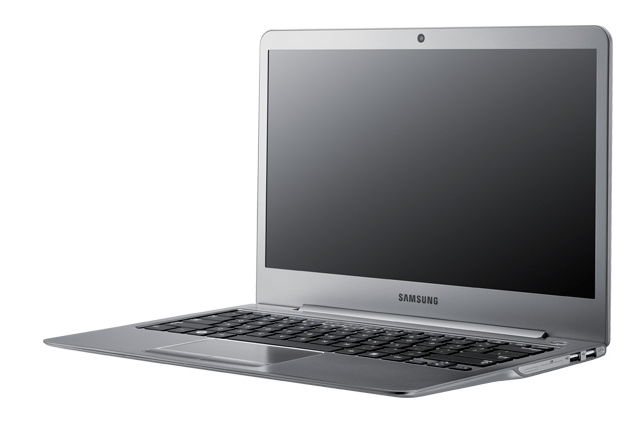
Samsung is taking the wraps off its 13-inch Series 5 Ultra TouchWindows 8
ultrabook today, and at a starting price of $809.99 for the Core i3
version, it’s one of the more reasonably-priced machines we’ve seen so
far. An extra $50 will buy you a Core i5 processor upgrade, but
otherwise, both models will have the same 1366x768 10-point touch
display, 4GB of RAM, and 500GB hard drive with 24GB of ExpressCache —
Samsung’s term for high-speed solid state storage directly on the logic
board. The Series 5 Ultra Touch isn’t breaking any records with its
3.83-pound weight, but it’s not bad for a machine with a spinning hard
drive.
The company also took a minute to touch on its renamed
Ativ Smart PC 500T and 700T Windows 8 tablets, which will be selling
for $749.99 and $1,199.99, respectively. While both will be running
Windows 8 and not the more limited Windows RT, that extra $450 will buy
you an Intel Core i5 processor (the 500T comes with an Atom Z2760), a
bump from 2GB to 4GB of RAM, and a doubling of storage, from 64GB to
128GB. No word so far on availability, but we’re expecting all of these
to be available for Windows 8’s October 26th launch.
Frankly, this is much better than the crappy ultrabooks out there under 1K$, and at least for now is one of the best buys out there